Winter is rose planting time. Bursting their buds in late spring and blooming right through summer and autumn (often well into May), roses are among the longest flowering plants in the garden. Winter is also the time to enjoy the greatest selection as a full new season's range arrives in garden centres. But don’t delay your visit; new releases and popular names are quick to sell out. By spring and summer, they will be in someone else’s garden. Here's 16 timely tips for beautiful roses.
- Buy only quality plants. Check that your local garden retailer stocks roses grown by the best growers in the country. They should be potted in quality mix to keep them healthy until you are ready to plant.
- Choose something new. Winter is an ideal time to plant new roses, which arrive in garden centres early June. Consider your priorities and take the time to choose the varieties you will most enjoy. Some excel as fragrant picking roses, others produce the most floriferous mass of garden colour, as hedges or elegant standard roses (minitrees). And there are roses that stand among the best of flowering shrubs as space fillers and ground covers.
- Say goodbye to poor performers or those past their ‘use-by’ to make room for a more desirable variety. Some varieties are more disease resistant than others and some are more tolerant of poorer soils. Or it might simply be time for a change.
- Choose a rose to fit your space, be it a bush, climber, standard or patio rose. Make sure you have the space and, if a climber, the support structure it will need.
- Give them a good start. Select a site in your garden that receives maximum sunlight, is sheltered from strong wind and has access to water.The best soil is reasonably well drained but has good water holding ability. Enrich the soil with compost or well-rotted manure. Sandy soils can be improved with organic matter mixed in at planting time and as mulch. A clay based soil suits roses well as it holds onto moisture and nutrients. However, if your soil is a heavy clay add some gypsum to improve aeration or create a raised bed, 15 – 20cm high.
- Do not replant a new rose where an old rose has grown. ‘Replant disorder’ occurs when a plant is replaced with the same type and it commonly occurs with roses, where new plants struggle to establish and may even die. If a new site to plant your rose cannot be found, dig a hole approx. 60cm wide by 30cm deep and swap the soil with fresh soil from another part of the garden plus a generous amount of compost.
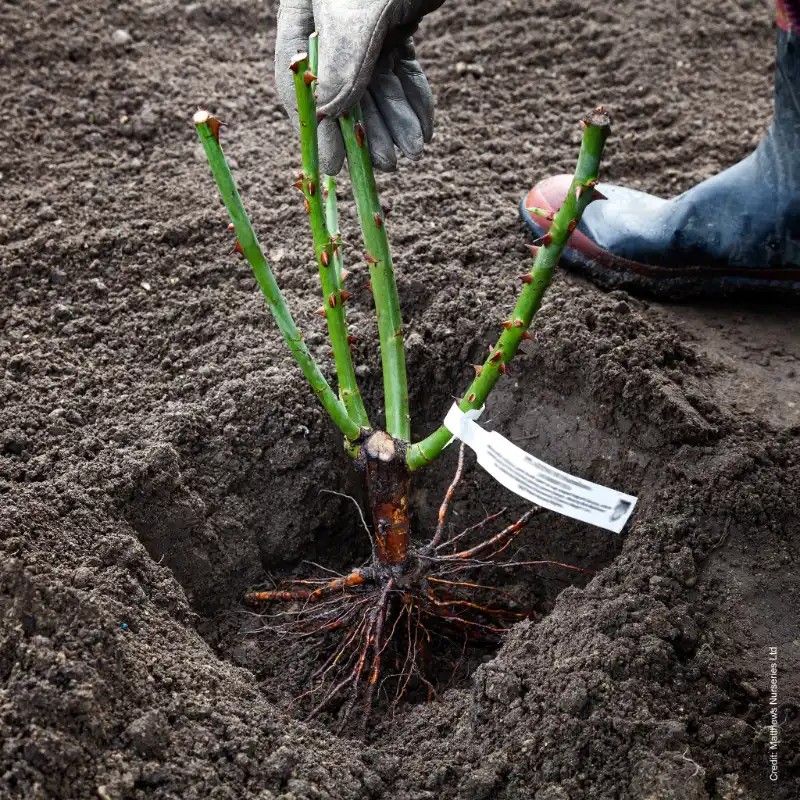
- New roses need pruning. In the field, the roses are mechanically pruned before being lifted for sale. Before you plant, cut away any damaged branches. Aim for 3 to 4 main leaders and with sharp secateurs cut the main leaders to within 4 to 5 buds from the base of the plant. If you are unsure, ask a garden centre team member to do this when you purchase your roses.
- Soak the roots of ‘bare-root’ roses (those sold with their roots in protective wrapping rather than in pots) in a bucket of water for 30 minutes before planting. Trim any damaged roots with sharp secateurs. Keep potted roses well watered until you get around to planting them.
TIP: Soaking bare root roses in dilute seaweed solution can help hydrate roots and promote healthy root growth. Use the soaking water to water the plant after planting.
- Dig a generous planting hole about 30cm deep and wide enough so the roots fit easily without bending. Make a small mound in the hole and position the roots over the mound so that the bud union of your rose plant sits about 5cm above ground level then backfill with soil, filling the gaps between the roots to eliminate air pockets.
- Water well & regularly. New roses need plenty of water. Apply a full 10L bucket of water after planting, and every other day for the next week if it doesn’t rain.
- Do not use fast-acting fertilisers until your roses start to grow. Aside from the waste as the food gets washed away before the plants can use it, fast fertiliser may also burn new roots that form early.
TIP: Apply rose fertiliser in spring, once shoots begin to appear, to support healthy growth and flowering. Controlled release fertiliser added at planting time will be activated as the soil temperature rises in time for new growth.
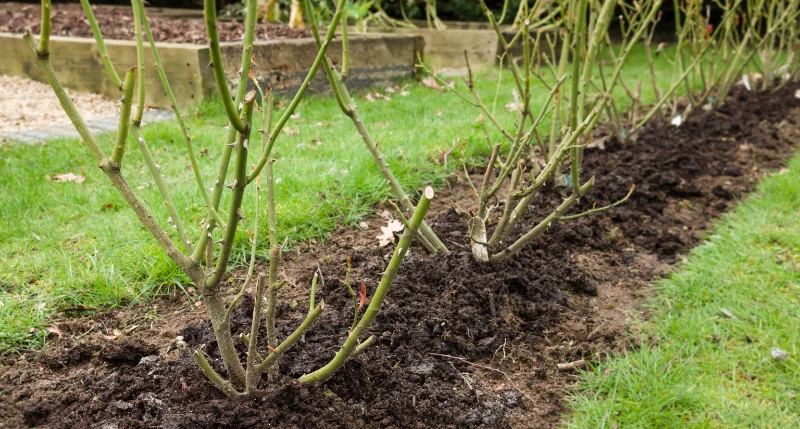
- Apply a layer of mulch. Compost or leaf mould makes an excellent mulch that will improve the soil, retain moisture and suppress weeds. Apply a layer 3-5cm thick but away from the crown of the rose bush
- A new place in the sun. Winter is an ideal time to relocate a rose that is struggling in an undesirable location. Poor flowering and leggy growth are signs that your roses want more sun. Roses that are close to buildings or overcrowded by other plants are vulnerable to pests and diseases, which thrive in sheltered or humid conditions.
- Prune established roses before spring. Pruning is the key task for July in warmer parts of the county, or August in colder climates. Remove wood that is dead, damaged or diseased. Then let light and air into the bush by cutting out growth that is crossed or growing towards the centre. Shorten back the remaining branches, cutting on an angle just above an outward facing bud. The spindliest wood is the least likely to produce flowers. If you're not sure where to start, your local rose society or garden centre may offer rose pruning classes.
TIP 1: Prune modern bush roses by a third to a half. Cut just above an outward facing bud, slanting away from the bud.
TIP 2: Stimulate new growth on old rose bushes by cleaning up around the crown using a wire brush to remove lichen and old scaly bark.
- A winter clean-up significantly reduces summer pests and diseases whose eggs and spores overwinter under rose bushes in leaf litter and prunings. Clear away the infested debris then finish off with a clean up spray. A good quality copper-based fungicide controls a wide range of diseases and is ideal for spraying during the dormant period. To minimise pests and break their life cycle, add spraying oil to the copper solution. Alternatively, a broad spectrum insecticide will significantly reduce spring and summer outbreaks of aphids, thrips and mites. When spraying, always follow the directions on the label and wear the appropriate safety equipment.
- Prepare for summer. Thirsty roses produce inferior blooms and are far more susceptible to pest and disease problems. Replenish a layer of organic mulch each year. Keeping the soil surface covered helps retain soil moisture while improving the overall water holding capacity and fertility of the soil as the mulch breaks down.
- One more tip. Enjoy. Your roses will give you months of pleasure every year for the rest of your life – that is money well spent.