


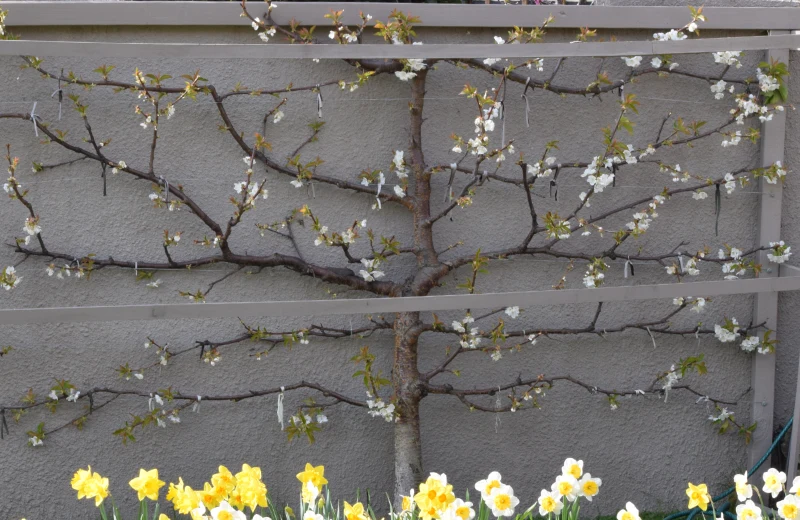

Winter is planting time for fruit trees. If you didn’t think you had space to grow apples and pears, you might want to reconsider. A fence or wall with a sunny aspect offers the opportunity to get creative and enjoy tasty fruit in season, even if your garden is small.
While it looks daunting, espaliering is not as difficult as you might think. The fruit tree is ‘trained’ along wires secured to your fence, garden wall or between posts to act as a natural garden divider. This technique helps to protect the tree from potentially damaging winds, assists fruit ripening and is more easily accessible and within reach when applying sprays, pruning, or harvesting.
Apples and pears are best grown on a horizontal espalier. Here, four to five wires are run (30-60cm apart) between secure posts. Typically posts are 4-5m apart with the tree planted mid-way between them. Alternatively, if espaliering against a wall or fence, wires can be attached to eyebolts. Ideally the wires should be 20-30cm away from the wall to allow air movement around the branches.
Initially, the vertical limb (main trunk) of the newly planted tree is supported by a bamboo stake. Once you’ve decided which branches to keep, use a sharp pair of secateurs to remove surplus branches. Your tree will then put its growth energy into the branches you wish to grow along the wire supports.
You will also need to prune the top of your vertical limb, so it doesn’t sprout branches out from the top of your espalier. Use soft ties to secure your branches to their wires.
Once the espalier is formed, regular maintenance pruning is needed to keep it in shape. A light shaping is done in autumn with a more major prune in winter while your tree is dormant. Continue to trim and tie selected growth along your wires.
Another traditional form of espalier is the ‘stepover’, whereby fruit trees (usually apples) on extra dwarf rootstocks are trained horizontally to create a decorative low border and provide fruit where space is limited. Trees are planted at 1 to 1.5m spacings and trained along a strong wire support to about half a metre high.
For stone fruit, quinces, figs or persimmon a fan shaped espalier usually works best, on wires set at a 45-degree angle. After planting, the main stem is cut at the height of the first fanned wire. Your tree will then produce multiple branches at this point which can be selected to run along the wires. Secure with soft ties and prune all but the main espalier branches. Find out if your plant bears its fruit on new or older wood, as this will determine which branches to train each season.
Select varieties, such as these listed below, which produce their fruit on spurs (short stubby clusters of tiny branches). Tip bearing varieties are not recommended for spaliers except for informal fan shapes.
Adore, Divine, Cox’s Orange Pippin, Initial
Ariane, Baujade, Golden Delicious, Hetlina, Peasgood Nonsuch
Lady in Red (Pink Lady), Braeburn, Splendour
Belle de Boskoop


For more information on varieties to suit your climate or to watch a ‘how to’ video, visit waimeanurseries.co.nz