
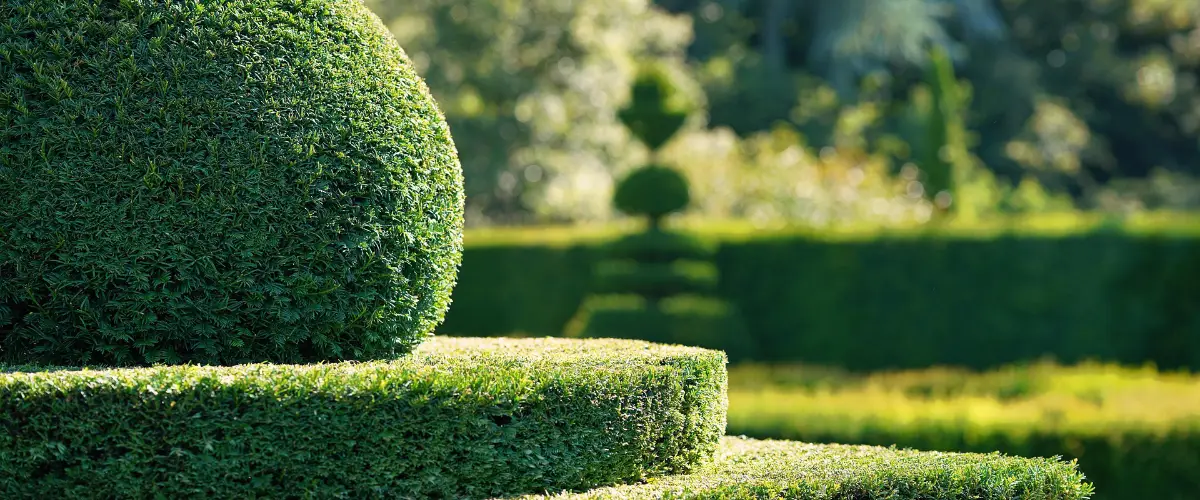
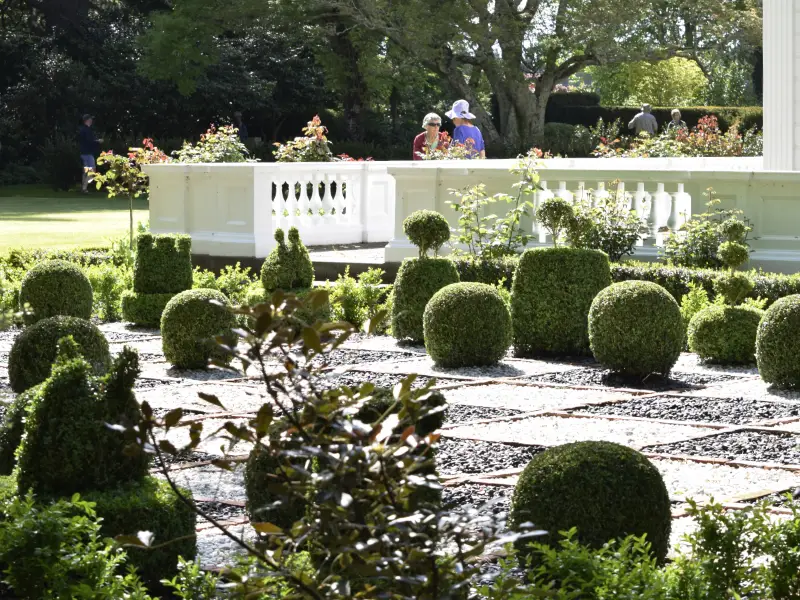


Smartly trimmed evergreens add accent and definition to a beautiful spring and summer garden. Then, while other plants sleep, they stand out with striking presence in winter’s sparseness.
The reliable box hedge, or Buxus, is a time-honoured favourite whose popularity stretches back centuries, and remains undiminished today. It responds beautifully to trimming, producing a uniform flush of fresh green growth. There are various Buxus species to choose from, all with small evergreen leaves, and dense growth of desirable darkest green. Box is easy to grow and its modest growth rate means it only needs trimming a couple of times a year and it has a long life. New Better Buxus® ‘Renaissance’ is resistant to Buxus blight.
Buxus blight is a fungal disease which causes areas of unsightly dieback, eventually killing the plant. It spreads via spores released in spring and enters the stems via pruning cuts or stress cracks. Removing infected parts and spraying regularly with copper, especially after pruning, can slow the spread. Improving air-flow around box hedges and keeping them free of debris will also help.
Offering different colours and growth rates, the choice of plants that are ideal for little hedges extends beyond box to a number of other compact, small leafed evergreens, including some exceptional New Zealand natives.
New Zealand native Corokias rate highly as hedge plants, with tiny leaves in colours ranging from olive green through greys and silvers to chocolate brown, and dense twiggy growth. Corokia 'Geenty's Ghost' can be kept as low as 25cm, with beautiful dense growth. Popular 'Geenty's Green' and 'Frosted Chocolate' suit a height of around 90cm. Corokias must have well drained soil.
Native coprosmas bring sparkle and shine with their shiny leaves and, in some, fine textured wiry growth. Chocolate toned Coprosma ‘Cappuccino’ is regarded as one of the best for shaping. Coprosma ‘Middlemore’ (mirror bush) catches the light with its bright glossy green leaves. Ideal in seaside gardens, coprosma hedges are very quick growing so need regular trimming. New growth is sensitive to frost.
Fast growing box honeysuckle, Lonicera nitida gives a fine smooth finish as a mid green hedge, but needs more frequent trimming than box to maintain tight growth.
Super quick growing, Teucrium fruticans dazzles in bright silver with interesting twiggy growth. It is very popular for fast formal hedging but demands more frequent trimming than any other hedge. For a lower-maintenance silver-grey hedge, Westringia (Aussie box) is a more refined and long-lasting choice, especially in hot, dry climates. Drought tolerant and quick to establish, it has fine grey-olive leaves and small white spring flowers. The compact Westringia ‘Grey Box’ is excellent for close clipped hedges and topiary, naturally forming a neat globe if left unpruned.
For a fragrant hedge, rosemary is quick and easy to grow. Upright Rosemary ‘Tuscan Blue’ is great for trimming into hedges and mounds. ‘Chef’s Choice’ makes a good smaller hedge under 50cm tall. With fragrant, red, edible berries in early autumn, Myrtus ugni trims to a very compact hedge with small leathery leaves and red new growth.
While tiny leaf shrubs are the best for sculpting smooth clean lines, slightly larger leaf shrubs bring extra texture. Viburnum, Ilex, Prunus lusitanica, and bay trees,. have attractive dark green leaves, although these are susceptible to thrips in hot dry conditions.
The shiny leaves of the Golf Ball pittosporums retain their mounded form naturally but also respond well to an occasional trim.

Autumn is a good time to plant a hedge. Purchase vigorous young plants of an even grade. In mid-late spring, once the newly planted hedge has had its first flush of new growth, cut it back by a half. Sacrificing some height now will pay dividends later; early pruning is critical to encourage thick, even growth. String lines will help you achieve a straight, even trim.
Most hedges require clipping twice annually - in spring and again in late summer. Fast growing hedges may need three or four trims per year. Beware of pruning too heavily later in autumn, however, especially in a cold climate. Any resulting young growth will be susceptible to frost damage.
Feed hedges and topiaries after trimming with controlled release fertiliser. Give them a good soaking during dry periods but avoid overhead sprinklers. Warm damp conditions can invite disease.
TIP: For healthy growth all the way to the bottom or your hedge, taper the shape so that it’s wider at the bottom than the top, to ensure the sun gets to all the branches.
Topiary is the age-old art of trimming plants into interesting shapes. It’s remarkable what can be shaped from a simple shrub, but before you try your hand at animals or sailing ships, perhaps start with something simple - like a ball or dome. Rounded shapes are restful and appealing and there is no need to be perfectly symmetrical. Japanese topiaries, for example, echo the shapes of rocks and mountains.

The best shrubs for topiary have small, closely packed leaves. The slowest growing of them live the longest and demand the least upkeep.
Favourite topiary shrubs include buxus and corokias. Juniperus ‘Kaizuka’ or hollywood juniper, is excellent for taller topiaries. A premier choice for cooler climates is very slow growing yew (Taxus baccata), which has very dense, dark green foliage and the ability to sprout from old wood. New Zealand’s totara, particularly the blue form, Podocarpus 'Matapouri Blue’ is a better choice of conifer in the North Island.