
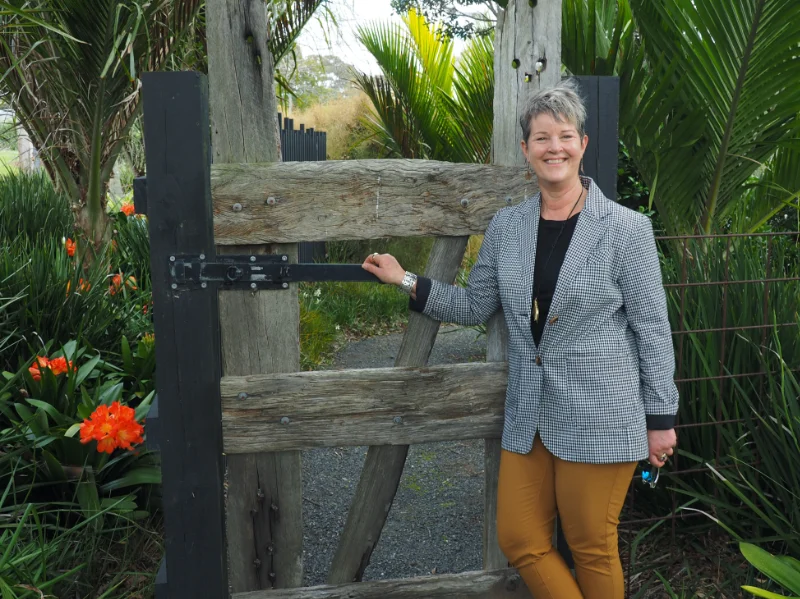
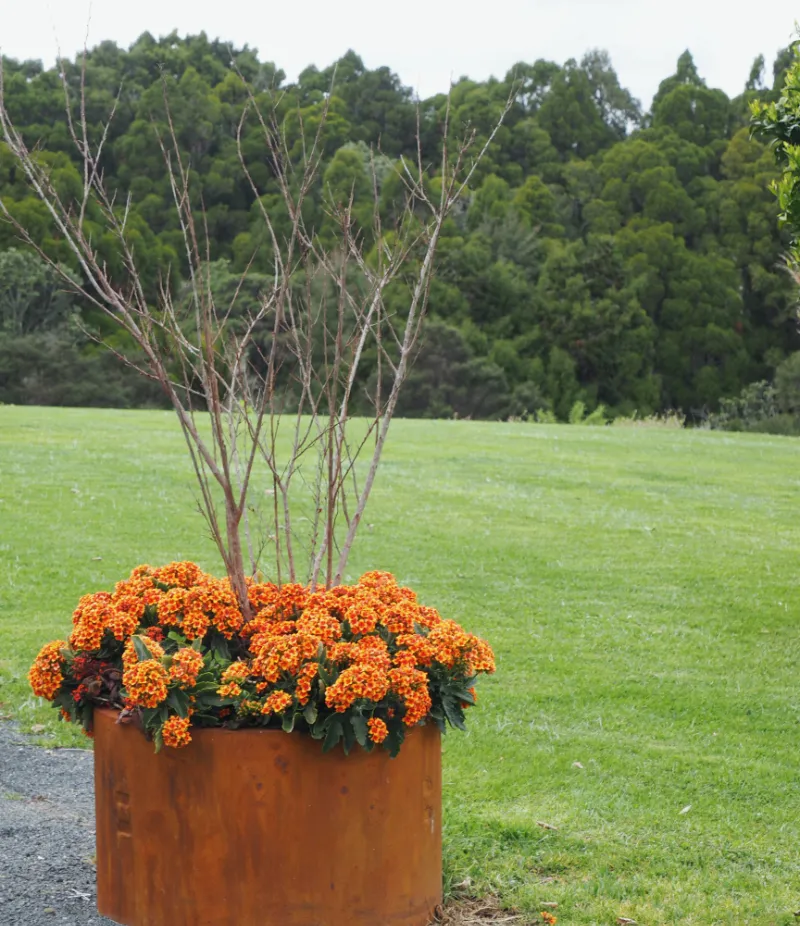
Nicola Rochester's fabulous Auckland garden is filled with plants that remind her of her friends. Recently,she gathered a bunch of them together for a garden party that celebrated 30 years of friendship within the nursery industry. By day, and then lit up magnificently at night, Nicola’s garden is the perfect place for a party, especially when it’s a gathering of plant buffs.
Nicola and her partner Mike Cato found their Whitford property at the emergence of the new Millennium. There was no garden back then. Just an old 1950s house ‘with potential’ sitting in a scruffy paddock. But the setting was magnificent. The panoramic backdrop to their four acre garden is six acres of native bush which expands across the view - an amphitheatre of mature rimu, kahikatea, celery pine and nikau. The bush is protected by QEII National Trust, New Zealand’s independent organisation that partners with private landowners to safeguard valuable native habitats.
“This is really important security,” says Nicola. “As landowners, we’re only here for a short period of time. The trees are here for much longer.”
“The good thing about QEII is that they come around once a year and it’s a great opportunity to walk around with them. They will alert you to any problems so you can get on top of it early. It’s the landowner’s responsibility to make sure their covenanted bush is well protected from stock and invasive weeds are removed,” explains Nicola.
In the foreground, mature pohutukawa trees frame the view. Planted just 20 years ago, they’re already taking on that distinctive gnarled beauty of much older trees. Nicola and Mike’s garden feels much more established than its 26 years - a testament to their landscape design flair and expertise in the tree business. Many of the trees in their garden come from Mike’s nursery, Icon Trees in Ardmore, which specialises in large grade specimen trees and advanced hedging.
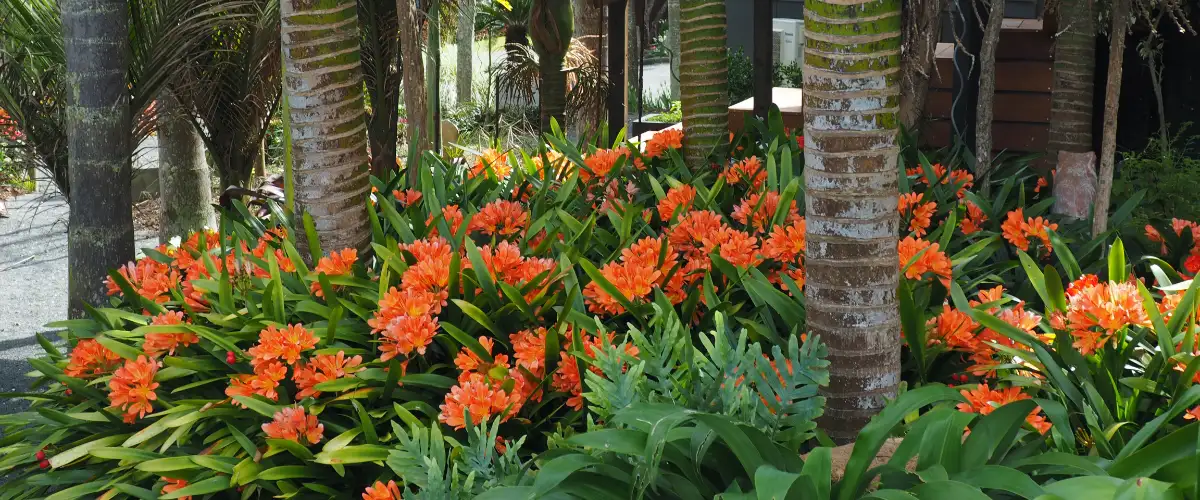
While native plantings prevail on their outer landscape, the gardens closest to the house blend natives with colourful exotic plants beneath a canopy of elegant palms.
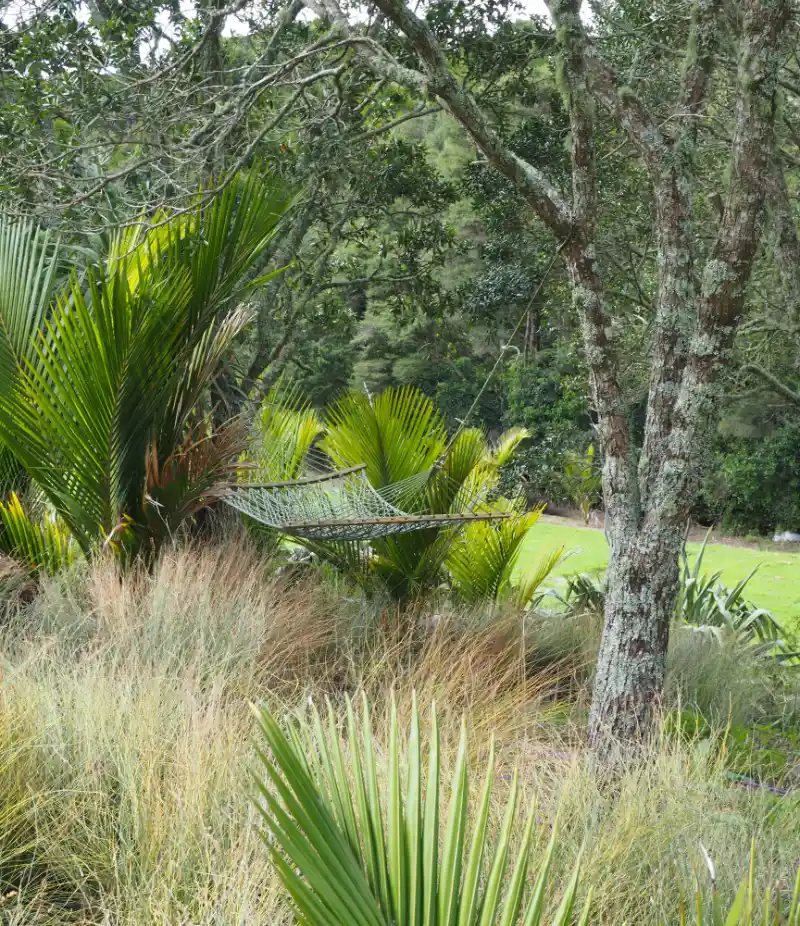
The garden flows seamlessly from a welcoming entrance courtyard, meandering around the house through palms and colourful shade loving perennials before opening out again onto a sunlit patio and sweeping greenlawns. Here, large flat rocks offer an inviting place to sit, sun-warmed, to savour the view and the tranquil sounds of nature.
Below here, a steep slope separating the garden’s two lawn terraces is clothed in a vast mass planting of the native rush, oioi (Apodasmia similis). After much experimenting, the oioi has turned out to be an excellent solution to the tricky terrain. As well as helping to block and screen the weeds, it looks fantastic, especially when it blows in the wind.
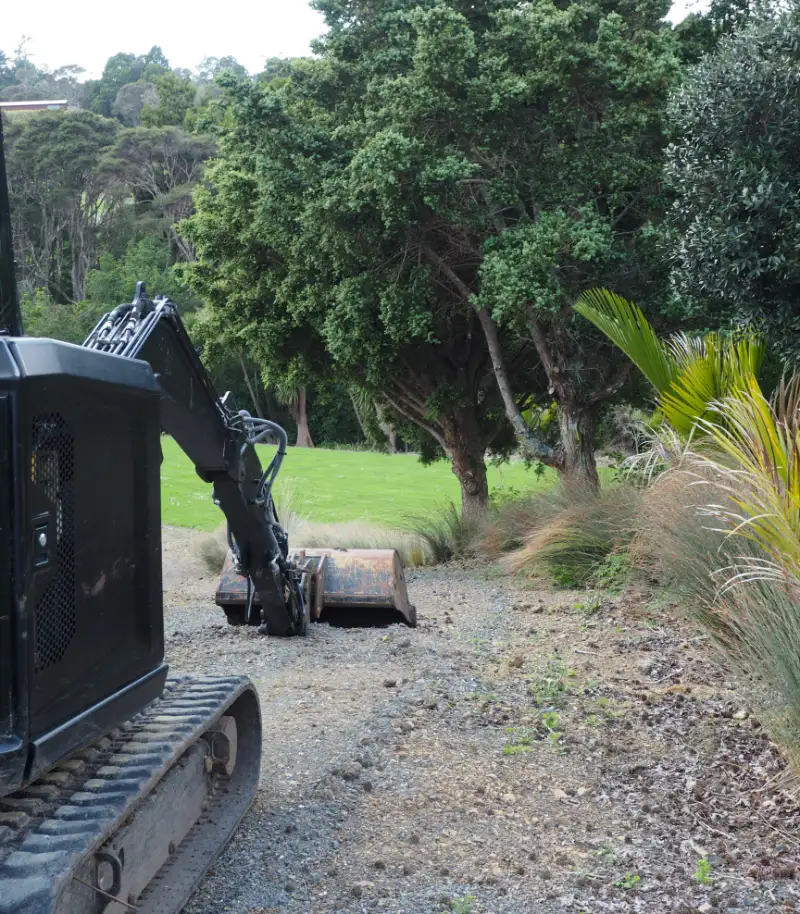
These expansive parts of the garden are mainly Mike’s domain. This big-tree nurseryman likes to do things on a grand scale. His favourite planting style is bold and confidant. His digger is Nicola’s favourite gardening tool. “The digger digs the holes and I follow along with the plants. Mike’s mantra is you wear out the machine, not the man! He’s really good at the big structure and I do the filling in.”
They started their garden with the major elements - the hard landscaping, the rocks and the trees for privacy. Looking back, Nicola is grateful they made the bold decision to remove some large gabion dividing walls. “Mike persuaded me and what a difference it has made! It’s fun to have transformation in a garden so we shouldn’t be afraid to make changes,” she advises.
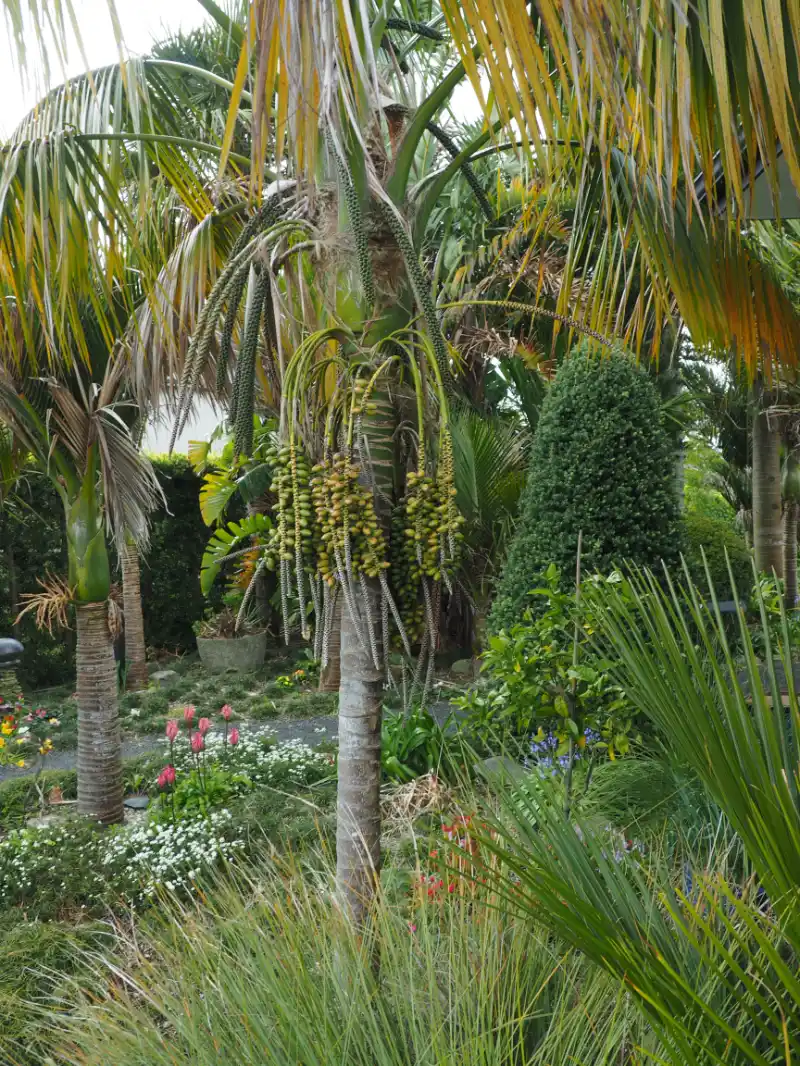
The palm trees were planted in stages, over the last 20 years. A cluster of quick growing queen palms (Syagrus romanzoffiana) now tower high above the house. Elegant kentia palms (Howea forsteriana) with wide arching fronds and smooth, ringed trunks are embellished with cascading seed heads. Tall slender New Zealand nikau (Rhopalostylis sapida) blend in beautifully, their bright red fruit a magnet for kereru and tui.
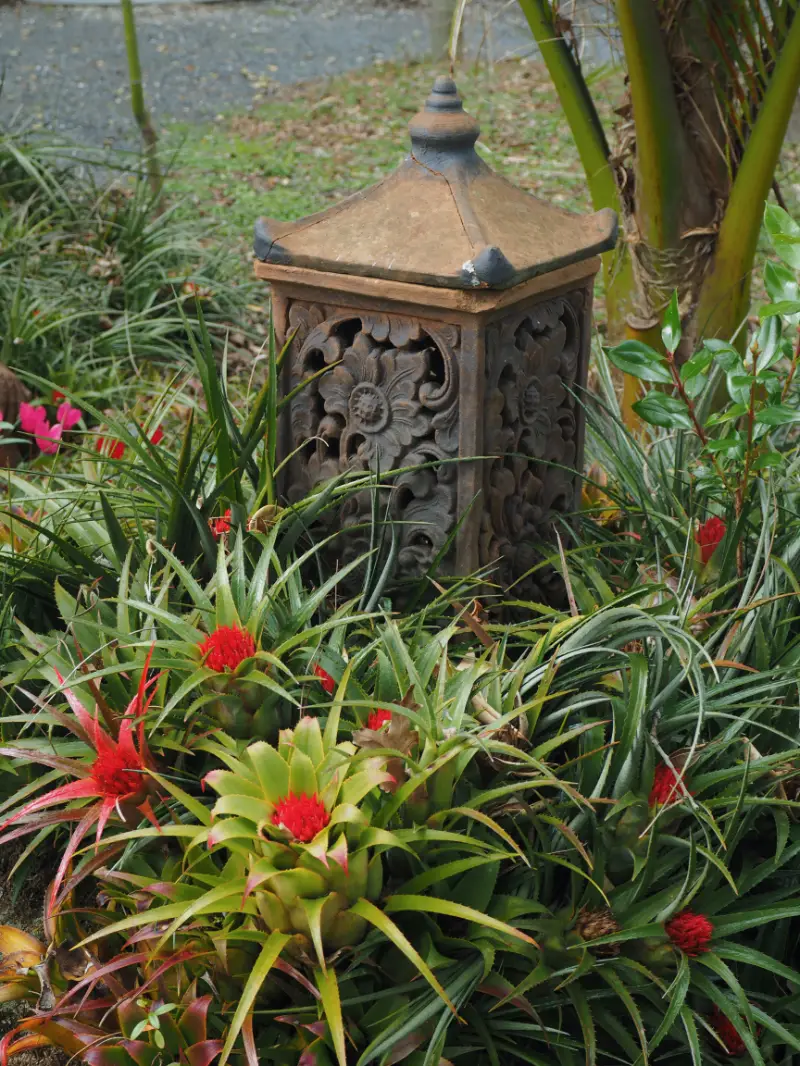
Beneath the palms, the artistry of a passionate gardener is unleashed. For the most part, Nicola knows instinctively what will work where,but she is not afraid of trial and error. “If you plant things that you like, it does gradually all work together,” she assures us.
But this garden isn’t just about the plants. It’s about their people. Admire any plant in Nicola’s garden and she will likely tell youa story about the grower who introduced it to her.
For example, there is the story of the two lancewoods(Psuedopanax ferox) which came from two different nurseries. For over 15 years, they grew side by side above a carpet of Selliera radicans, and then one day she noticed a whole seed bed of baby lancewoods popping up through the groundcover.
Elsewhere in the garden, she points to another meaningful ‘relationship’, this time between a pair of spectacular grass trees from two different countries – one from Queensland, the other from Mexico.
Having spent three decades visiting nurseries all aroundthe country, Nicola cherishes the connections she’s made with New Zealand’s top growers and the insights she’s learned along the way.
“You can’t help but be inspired by the depth of horticultural expertise in our nurseries, the techniques and craftsmanship that you can’t possibly learn on Google! There are all the intricacies of grafting, specific propagation and seed collecting skills. When you walk around the nurseries with their owners, you realise how incredibly knowledgeable they are.”
It’s really important, she feels, the we understand the immense effort that goes into getting plants to the stage we see them in thegarden centre. Often, it’s the result of years of careful selection and cultivation. She recently visited a plant breeder’s tunnel house where 20,000 flower seedlings had been grown to allow for the selection of specific traits. “That’s 20,000 plants of the same variety! Ten years from now, he might have something truly unique.”
Nicola found her passion for horticulture early in life. As a small child she was given her first patch of garden to play with. Then, when 12-year-old Nicola wanted to earn some money, she found a job at a local nursery. “I absolutely loved it. When the school careers adviser asked ‘what do you love?’, I thought well, I love plants and I love science.” Ever grateful for her career choice, she says her Horticultural Science degree at Lincoln University was an incredibly versatile degree that offered a wide variety of papers.
Her honours degree majoring in nutritional biochemistry and biometrics introduced her to the world of trials and statistics, skills that continue to play a crucial role in her work. She loves using the knowledge she’s accumulated to help her nursery clients find optimal nutrition solutions for their container grown plants. It’s an exciting career that involves plants, science, travel and people - all the things Nicola loves.
“These days, I get to enjoy having the knowledge while still learning something new every day. I love nutting things out, figuring out how we can do things better. The enjoyment comes from getting results and seeing the fruits of your labour.”
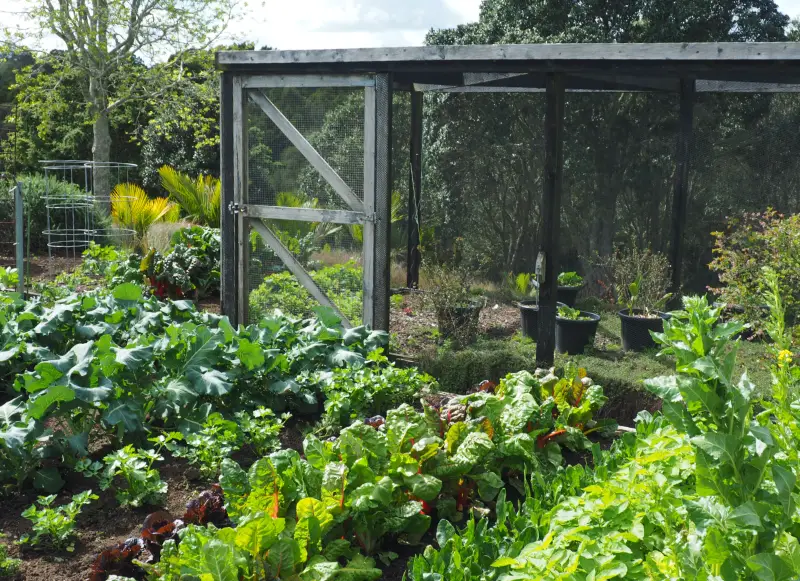
The other fruits of her labour are the ones she harvests from her garden. In her large vegetable garden she grows everything from Popeye spinach to Christmas potatoes and asparagus - enough for her own kitchen and to share with friends and neighbours.
She’s also passionate about helping others experience the joy of growing their own food. To Nicola, getting people excited about gardening starts with the end result - the rewards of homegrown produce. “It’s becoming a lot more common for people to want to know what’s in their food,” she says. “There are real health-based reasons behind wanting to grow our own.”
Next to Nicola’s raised vegetable garden, a berry cage protects her blueberriesand strawberries from the birds. She is thinking about a young niece coming from Italy this Christmas. “When she first came at age three, watching her pop a blueberry into her mouth was one of those delightful moments. This time I’ll have strawberries for her.”
Nicola is also looking forward to harvesting her first bananas this year and is excited about the prospect of growing more of them in a warming climate. Meanwhile, her heritage Ballarat apple tree makes delicious apple pies, but it is citrus that grows best in her Auckland climate.
“With citrus trees, it’s crucial to maintain consistent watering,” she notes, especially when they’re in pots. Recently, one of her potted orange trees appeared to be on the brink of succumbing to borer damage. She transplanted it into the vegetable garden, providing it with unlimited access to water and nutrients. Now, she’s impressed by the strong growth, which seems to be outpacing the borer issue. “I love being able to harvest every orange and every grapefruit to make syrups and marmalade. The best part is the joy I get from presenting my own preserves as gifts.” She even grows her own ginger and turmeric in large pots to use in her syrups.
Nicola the scientist has discovered a nifty way to test for pectin in preserves. “To find out how much pectin you’ve got for setting, all you need to do is pour a little bit of methylated spirits over a teaspoonful of the boiled juice (before you add the sugar). If it gels straight away it’s got enough pectin and it’s going to set.”
As a fertiliser expert, Nicola understands plant nutrition better than most. In spring, plants need feeding to keep up with the boost of growth and productivity, especially when grown in pots. But she also advises against applying too much fertiliser at once, which can be worse than not using any at all.
The most important thing is to look after the soil. “Keeping it covered is so important. We use truckloads of Daltons mulch and compost. Also, it’s taken me years to get to the point that I’m happy to chop and drop – just leaving my pulled out weeds lying on top of the soil. But now I think, get over yourself if you think everything has to be tidy. It’s so much better to have some cover. It all rots down and next time you sink your fork into the soil it feels so much better and it’s teeming with life!”
She is careful, however, to remove invasive weeds before they set seed. “I’m really good at whipping around every few weeks and pulling out the weeds that are flowering. When you think about it, a single flickweed can make 5000 seeds!”
Whether she’s weeding or planting, Nicola loves being on her knees with her hands in the soil. “If you lose yourself in gardening then you’re forgetting about the stresses of your day. A tui will fly over, a kereru will swoop, or something little will scuttle in front of you. It’s just pure joy being amongst all that living!”